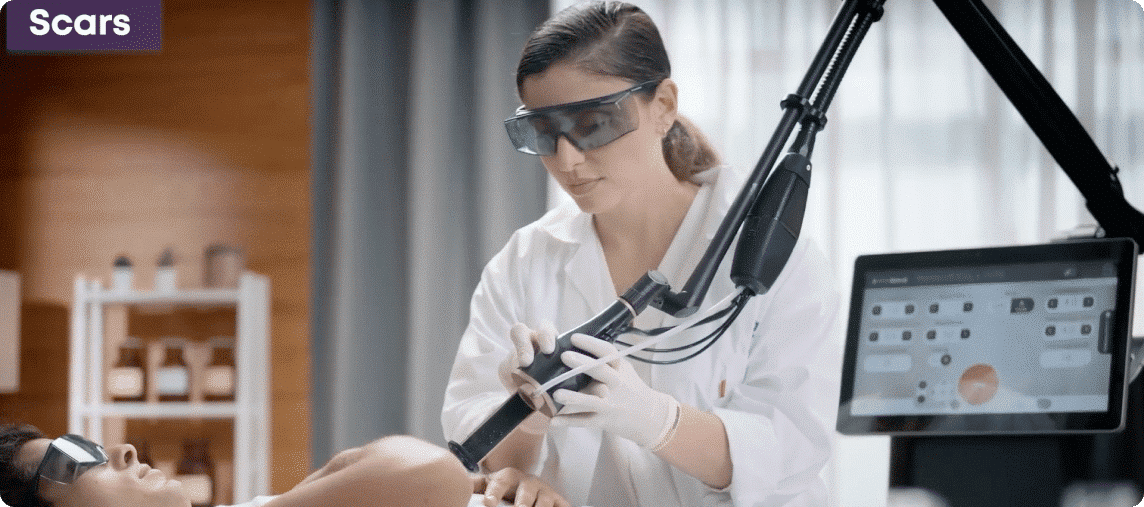
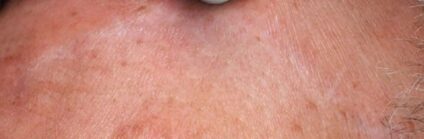
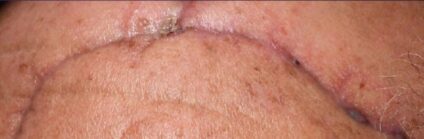
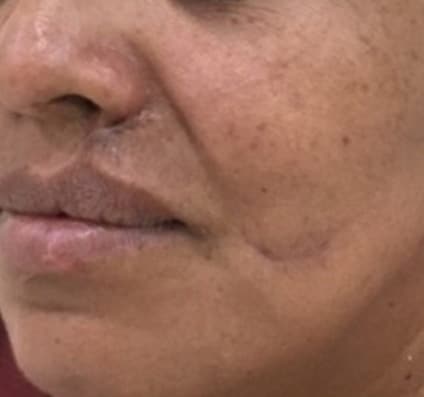
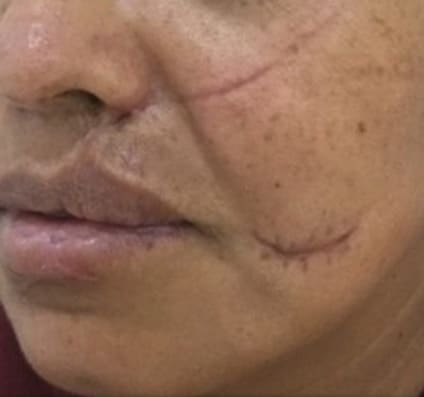
Experience Alma's advanced scar treatment solutions, using laser technology to effectively reduce the appearance of scars, including those caused by trauma or surgery. Laser treatments are designed to safely promote the growth of smoother skin tissue, enhancing both appearance and confidence.
What is scar revision?
The physical appearance of a scar can make a person feel unattractive, insecure, or undervalued by society, while also being a permanent psychological reminder of the trauma that caused it. Treating scars is therefore more than a matter of aesthetics; it can give a patient a whole new lease on life. Alma’s range of state-of-the-art, non-surgical solutions significantly improve the appearance of scars.
Is scar revision right for you?
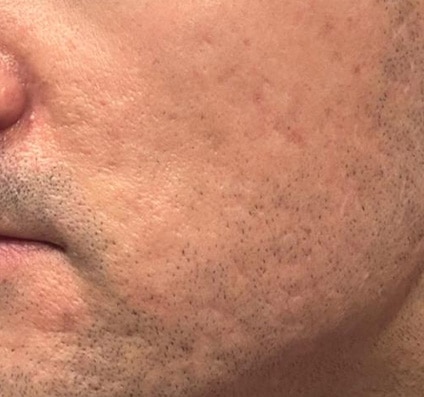
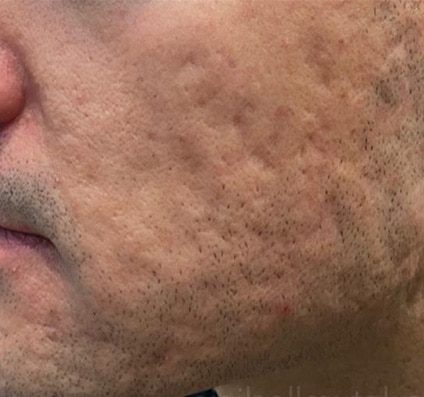
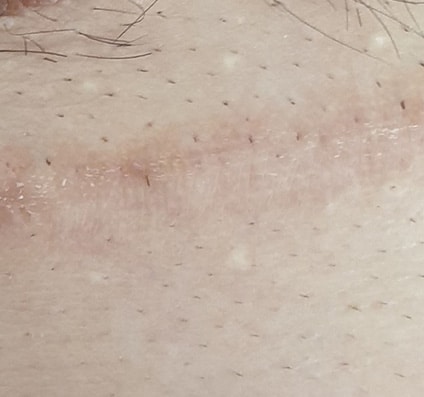
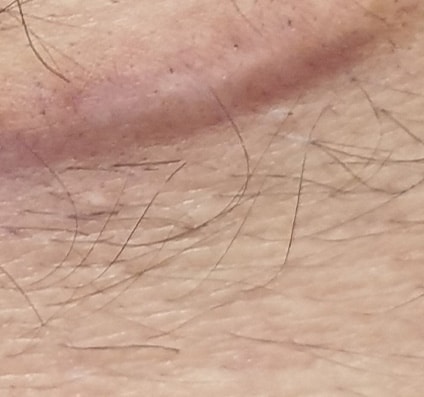
Alma’s scar revision treatments are suitable for a variety of scars, including those caused by acne, trauma or surgery.
Acne scars
Trauma scars
Surgical scars
How does it work?
Alma’s laser technology works by creating micro-wounds to break down the scar tissue, triggering new, smoother skin tissue to grow in its place.
The Alma Advantage
The range of scar revision treatments offered by Alma covers different patented energy-based technologies, working together to deliver superior results.
Minimal Downtime
From as little as 2 days, depending on required treatment intensity
Safe for Any Skin Type
Treatments are safe for different skin types
Clinically Proven
Technology is backed up with clinical studies and publications
Customized Treatments
Suitable for a range of scar types, on the face and body
What’s Your Scar Concern?
FAQs
Yes, once the scar has fully healed. A caesarean scar is a surgical scar, and fractional laser treatment is used to soften its texture, flatten a raised or thickened section and even out its colour so it sits closer to the surrounding skin.
Clinics using Alma Hybrid treat the scar with ablative CO2 and non-ablative 1570 nm in the same pass, which allows the depth to be set for a scar on the lower abdomen and keeps recovery short; Alma Pixel CO2 is used for the fractional CO2 pass alone.
The best window is the first year after the birth, while the scar is still remodelling, but older scars can also be improved. Treatment is usually a course of sessions several weeks apart, with numbing cream. Your clinician assesses the scar first: one that is still healing, infected or keloid-prone needs a different plan. Results vary from person to person.
Yes, this groundbreaking technology is suitable for use on all areas of the body and face.
Alma’s top scar revision products are Pixel CO2, Alma Hybrid and Opus. Harmony XL Pro and ALMA-Q can also be used.
This treatment causes minimal pain. For more extensive scarring, topical numbing cream may be applied before treatment.
Scar revision involves a series of several treatments in order to achieve optimal results.
Laser for surgical scars: which treatment, and when
Laser treatment can soften, flatten and fade a surgical scar, but the right laser depends on the age of the scar, whether it is red and raised or pale and indented, and your skin tone. In Australian clinics using Alma technology, surgical scars are usually treated with fractional laser to remodel the scar tissue, Q-switched or narrowband light to settle redness, and, for burn or textured scars, fractional plasma. Treatment starts once the wound has fully healed, and early treatment generally gives the best result.
Scar type
What works
What happens
Typical downtime
Alma option
Fresh surgical scar (healed, still pink)
Early fractional treatment, often combined with a vascular setting for the redness
Remodels the forming collagen so the scar stays flat and narrow; redness settles
1 to 5 days depending on depth
Alma Hybrid (CO2 plus 1570 nm) or ClearLift on Harmony XL Pro
Mature surgical scar (pale, indented or ropey)
Fractional CO2 with a non-ablative pass, or fractional CO2 alone
Micro-columns of treatment trigger new collagen and blend the scar edge into the surrounding skin
3 to 7 days
Alma Hybrid or Alma Pixel CO2
Red or purple scar
Narrowband light or long-pulsed 1064 nm targeting the blood vessels in the scar
Vessels close, redness fades over the following weeks
Little to none
Dye-VL or the vascular applicators on Harmony XL Pro
Raised (hypertrophic) or keloid scar
Fractional laser combined with the practitioner’s medical management
Flattens and softens; keloids need a combined plan and can recur
3 to 7 days
Alma Hybrid or Pixel CO2, with a dermatologist or plastic surgeon managing the keloid
Burn scars and post-burn pigment
Fractional plasma radiofrequency
Improves texture, tightness and pigmentation in published series of burn patients
A few days
Alma Opus (Pixel RF microplasma)
Acne scars
Fractional resurfacing, or Q-switched 1064 nm for darker skin
Rebuilds collagen under the pits and evens the surface
1 to 7 days depending on the option
Alma Hybrid, Pixel CO2 or ClearLift
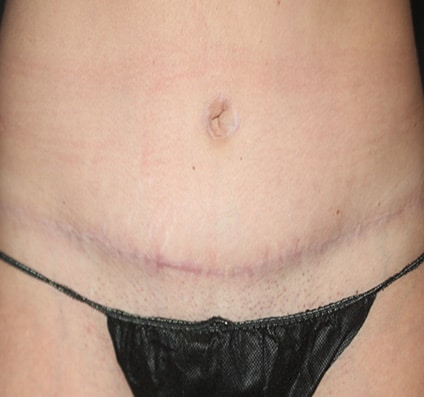
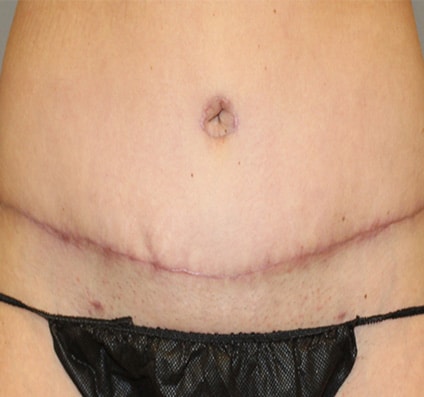
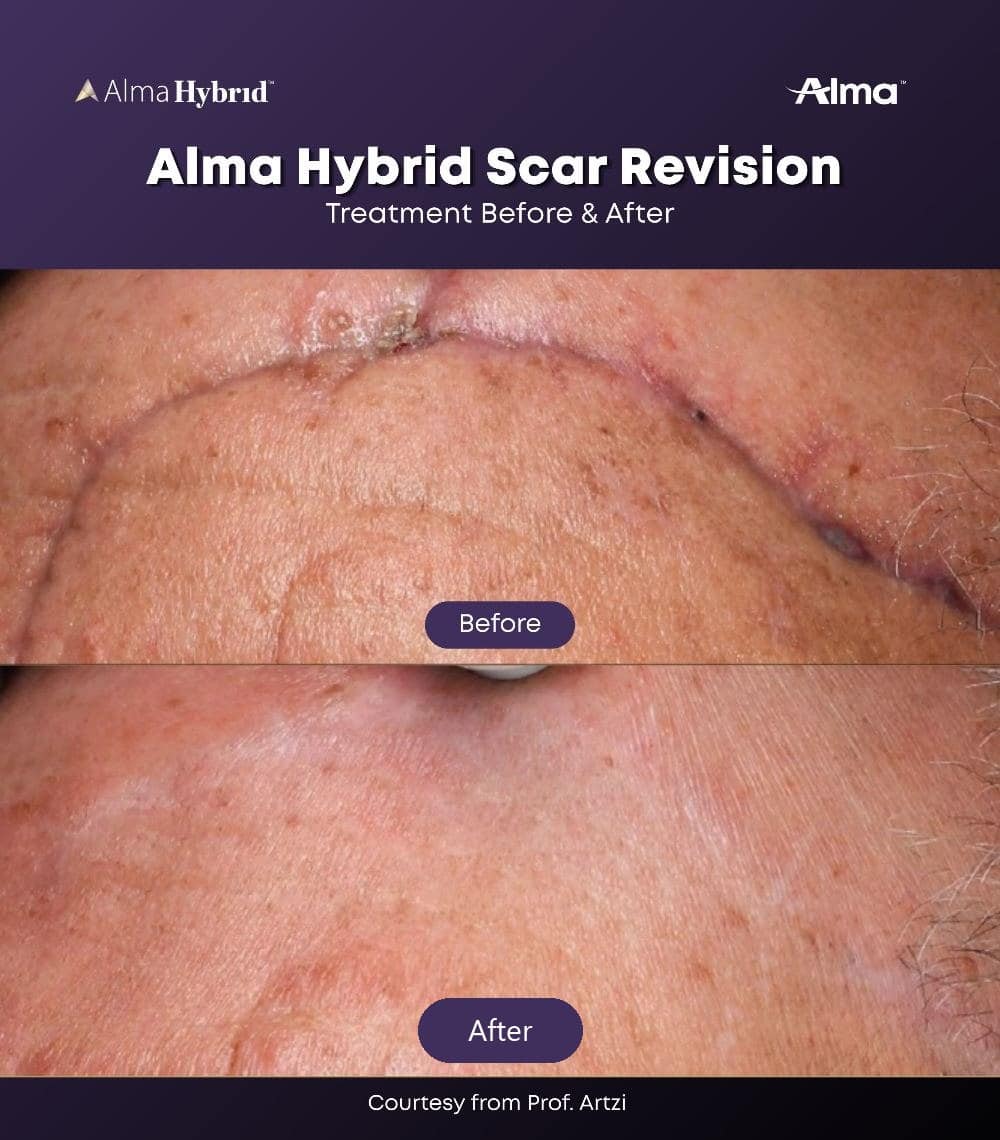
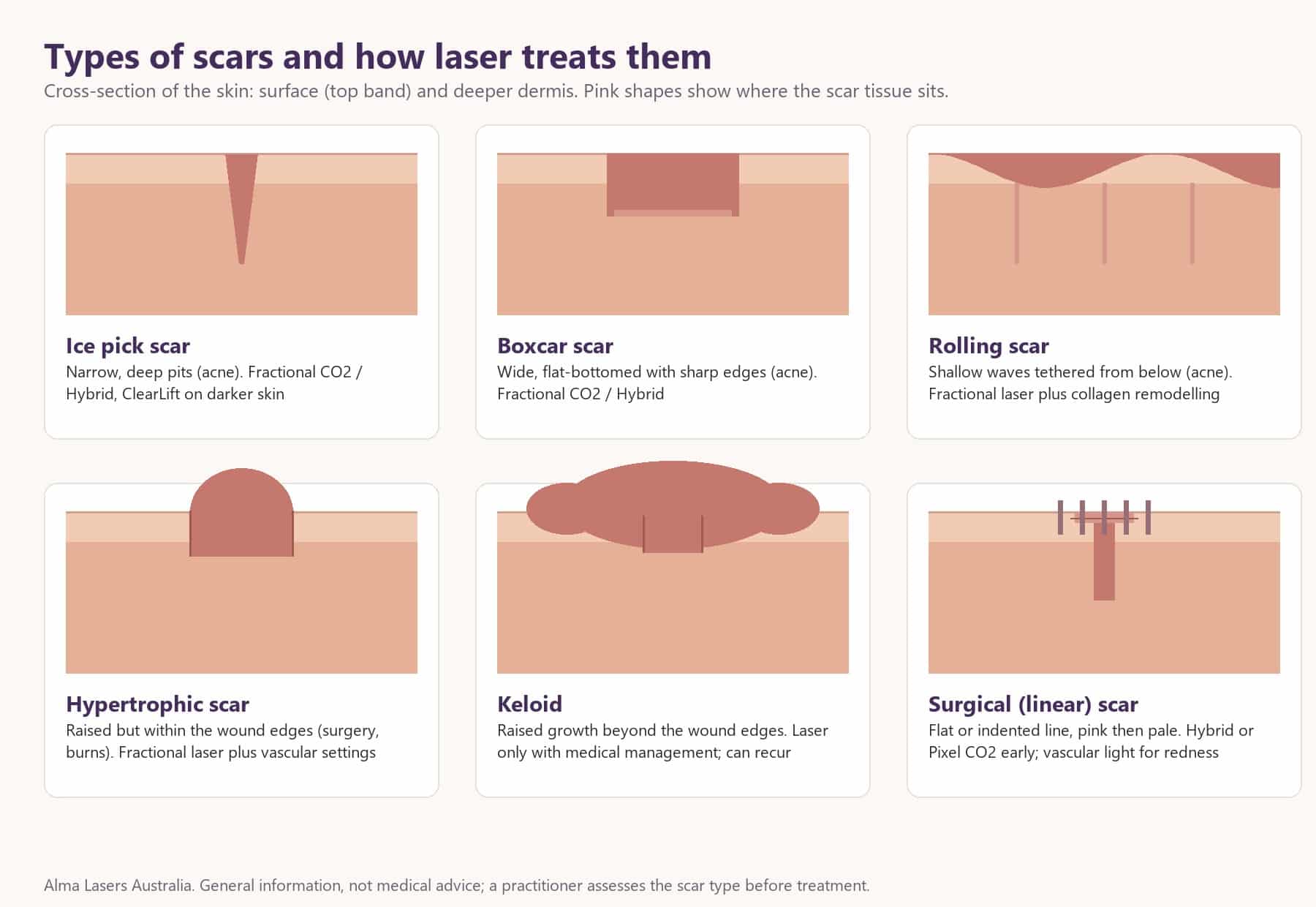
A surgical scar before and after a course of Alma Hybrid scar revision. Image courtesy of Prof. Ofir Artzi. Alma receives before-and-after images from device users and, to the best of our knowledge, cannot confirm whether other treatments or skincare were combined. Individual results, suitability and downtime vary; outcomes are not guaranteed.Scar types in cross-section and the laser approach used for each. Illustration: Alma Lasers Australia.
Know your scar type
Ice pick scars are narrow, deep pits, usually from acne. They need energy delivered deep into the skin, so fractional CO2 or Hybrid is used, with ClearLift preferred on darker skin.
Boxcar scars are wider, flat-bottomed depressions with defined edges. Fractional resurfacing softens the edges and lifts the base over a course.
Rolling scars are shallow waves tethered by bands under the skin. Fractional laser breaks the tethering and stimulates collagen so the surface evens out.
Hypertrophic scars are raised but stay within the wound edges, common after surgery and burns. Fractional laser flattens them, and vascular settings calm the redness.
Keloids grow beyond the wound edges and can keep growing. Laser is used only alongside medical management by a dermatologist or surgeon, and keloids can recur.
Surgical (linear) scars start pink and settle pale, sometimes indented or ropey. Early fractional treatment with Hybrid or Pixel CO2 changes how the scar matures; narrowband light fades the redness.
Burn scars are often tight and pigmented; fractional plasma (Alma Opus) improves texture and colour in published series.
How Alma Hybrid treats a scar
Every scar and every patient tolerates downtime differently, so the practitioner sets three things for each session: how deep the laser works, how much coagulation (controlled heating) it applies, and how dense the treatment grid is. Hybrid treats at two depths in a single pass, the CO2 for the surface and the 1570 nm laser for the deeper collagen, and can finish with the IMPACT ultrasound applicator to push topical products into the treated channels. That is why the same platform can treat a fresh scar gently and a mature scar more strongly.
When to start. Once the surgical wound has closed and any stitches are out, usually from six to twelve weeks after surgery, and sometimes earlier under the surgeon’s guidance. Scars keep remodelling for a year, and laser in that window changes how they mature. Older scars still improve, but usually need more sessions.
What the published studies found
Findings summarised from the papers; each card links to the original. Full list on our clinical evidence page.
Lasers in Medical Science · 2021
Fractional 1064 nm Q-switched laser for post-surgical facial scars
Safe and effective for post-surgical facial scars, including on skin types where fractional CO2 carries more pigment risk.
Study results were obtained under research conditions; improvement is gradual and partial, results vary from person to person, and a consultation with a qualified practitioner comes first.
Scar revision: questions patients ask
Which scars can be treated?
Acne scars, surgical scars, traumatic scars and burn scars can all be improved. Raised, pitted and discoloured scars respond to different applicators, so the plan is individual.
Which Alma treatment is used?
Alma Hybrid for texture and depth, Alma Opus where a shorter recovery is preferred, and Harmony XL Pro applicators for redness, pigment and non-ablative remodelling.
How much improvement is realistic?
Scars are softened and blended, not erased. Most people see gradual improvement over a course, with collagen changes continuing for months after the last session.
How many sessions?
Typically three to five sessions spaced four to eight weeks apart.
Is there downtime?
From none (non-ablative) to about a week of redness and crusting (deep Hybrid settings).
How soon after surgery can a scar be treated?
Often once the wound has fully healed, with your surgeon’s agreement. Early treatment can help how a scar matures.
Can a caesarean scar be treated?
Yes, once it has fully healed. A caesarean scar is treated like any surgical scar: fractional laser softens the texture, flattens a raised section and evens the colour so it sits closer to the surrounding skin. Clinics using Alma Hybrid set the depth for a scar on the lower abdomen and keep recovery short. The first year after the birth is the best window, while the scar is still remodelling, though older scars also improve. Your clinician assesses the scar first and sets the plan.
Where can I find a clinic near me?
Over 450 clinics across Australia and New Zealand use Alma technology. Tell us your suburb and treatment and we will point you to a clinic in your area.
This information is general in nature. Suitability, results and pricing are assessed and set by the treating clinic. Results vary between individuals.
Prepared by Alma Lasers Australia, the Australian subsidiary of the manufacturer, from the device documentation and the published studies listed on our clinical evidence page. It is general information, not medical advice; a consultation with a qualified practitioner comes first. Last reviewed September 2026.
We use technologies like cookies to store and/or access device information. We do this to improve browsing experience and to show (non-) personalized ads. Consenting to these technologies will allow us to process data such as browsing behavior or unique IDs on this site. Not consenting or withdrawing consent, may adversely affect certain features and functions.
Functional
Always active
The technical storage or access is strictly necessary for the legitimate purpose of enabling the use of a specific service explicitly requested by the subscriber or user, or for the sole purpose of carrying out the transmission of a communication over an electronic communications network.
Preferences
The technical storage or access is necessary for the legitimate purpose of storing preferences that are not requested by the subscriber or user.
Statistics
The technical storage or access that is used exclusively for statistical purposes.The technical storage or access that is used exclusively for anonymous statistical purposes. Without a subpoena, voluntary compliance on the part of your Internet Service Provider, or additional records from a third party, information stored or retrieved for this purpose alone cannot usually be used to identify you.
Marketing
The technical storage or access is required to create user profiles to send advertising, or to track the user on a website or across several websites for similar marketing purposes.